Why I got on the Roids

Instant Family Polaroid in Mauritania

Instant Family Polaroid in Mauritania

January 16th 2013

Off the corner of a dark laneway in Melbourne’s CBD my hands tremble with a tightly rolled stack of pineapples.* Sweat lines my brow as I check and double-check if anyone’s watching. The dealer looks me in the eye and my stomach drops. I hand over the cash. She passes me an innocent looking 12 X 15 centimetre box and hurries away inconspicuously – why was she wearing a nametag? It’s my first time, but I have no idea yet that it won’t be my last.

February 15th 2013

Just a month after my first hit the addiction has taken over. I’m stuck in a Mad Max-esque desert city capital in the middle of the Sahara. I’m a changed man, sharing my addiction, dolling out fixes to kids, grandmothers and anything in between. To keep under the radar I start hanging out in the fishing district of town and keep the company of Senegalese immigrants. I call them my friends but as the days go by I gradually share my habit with them too – even with their mothers. I’ll do anything for that sweet smile, that smell, that click, that instant gift. I’m addicted and it’s an expensive drug: Roids, Instant Polaroids. Guffaw.

————————————————————————————————————————————————————-

Getting on the Roids – wink wink- (i.e. giving instant Polaroid photos to the people I meet and photograph while travelling) is something I wish I started doing long ago. I usually offer to email digital copies to people I photograph along the way – and sometimes prints too – but there is a simple charm to an instant Polaroid that can’t be posted or emailed when you get back to civilisation. It makes the act of photography a tangible exchange that involves giving, not just clicking the shutter and pointing at the results on an LCD screen. Some people I meet have never had their photo taken and many don’t even have an address I could send them prints to, let alone an email to send JPEGs. So in many cases even a humble credit-card sized Polaroid can become a powerful gift, and as a bonus it’s a great way to make friends too.

In February I spent several weeks in Mauritania holed up waiting for a visa in the capital city of Nouakchott. In my spare time between hassling admin staff at the Senegalese embassy, I started making trips to the local beach/fish market. I became fascinated with the fishermen (most of whom are originally from Senegal) and decided to do a small project. After scouring the beach with a guide I met Mohammed, who let me photograph his day’s work 25 kilometres out at sea on a decorative, ten-metre, five-man fishing pirogue. We became good friends and he later invited me home to visit his family in a humble suburb called Five-M, where I returned on several occasions to hang out, watch Spanish soccer matches, eat ‘tiep bou djen’ (a Senegalese specialty mixing fish, tamarind, lime, chilli and vegetables on a bed of fried rice) and photograph his family. In this photograph Mahommed’s mother is nursing her granddaughter in one arm and in the other a fresh Polaroid family portrait. It’s a small memento, but one that smiles and – I hope – shows why I’ll be back at that dodgy camera store in Melbourne’s CBD picking up a fix of more Polaroid cartridges… or maybe not, it’s way cheaper off eBay!

Till next post,

Cam.

* ‘Pineapples’ is Aussie slang for $50 notes, which are yellow in colour.

Changing Tide

ChangingTide-p1-2

It may have been a three-month dearth of posts here on the blog but in my (real) world it’s all been happening. A book launch, wild adventures in Africa, a shoot for Oxfam Australia and new polaroid experiments will all be featuring here soon. For now though I’m sharing my latest published article in Get Lost Magazine. To read it download the pdf, pick up the current issue of Get Lost at any major newsagency (in Australia) or download the mag via the Apple App Store (just search for Get Lost).

Till next post,

Cam.

Party On Treasure Island

GL-35-Party-on-Treasure-Island-Article

Last September I was lucky enough to visit Samoa on assignment for Get Lost Magazine to experience the Fa’a Samoa (the Samoan Way) and a major week-long annual cultural event called Teuila Festival.

My responsibilities?

  • Have a good time.
  • Take kick-arse photos.
  • Come back with a story.

To find out if I fulfilled my duty check out the article just published in the current issue (Jan-March 2013). You can download it as a pdf, read it in this post below or if you’d prefer it in all it’s glossy ink-on-real-paper glory pick up a hard copy from your local newsagent (or order online).

Cheers,

Cam.

PARTY ON TREASURE ISLAND

Cam Cope’s sense of masculinity takes a beating in the festive heart of Polynesia.

'Party on Treasure Island' festival feature article published in the January-March 2013 quarterly issue of Get Lost magazine featuring my words and pictures.

‘Party on Treasure Island’ festival feature article published in the January-March 2013 quarterly issue of Get Lost magazine featuring my words and pictures.

Blondie’s powerful hands grip my shoulders and drive me up against a pole. Her muscular thighs lock around me and I’m at the mercy of her gyrating hips. Like a hunter’s spotlight on a frightened rabbit, her eyes beam into mine. I’m pinned with no escape and am about to be grinded by a 90kg Samoan drag diva.

Up close I notice the mascara running down to her five o’clock shadow, before she leans in theatrically for a kiss. The crowd erupts in rapturous shrieking. Wince. I dodge her aim and somehow manage to escape with no more than a splash of tropical sweat and a stubble-graze. Is this what rugby feels like?

I’ve just flown halfway across the Pacific for Teuila Festival, a celebration of traditional Samoan culture and one of the largest annual events in the first nation this side of the international dateline. Somehow I’ve ended up at Maliu Mai Bar and Grill for a drag show. It’s the last thing I expect to experience but it’s
a fascinating window into a part of Samoan culture far more traditional than it might first appear.

Blondie gives me a wink and saunters back to centre stage before finishing her pantomime to a rousing reception. She, like the rest of the performers, is a member of a third gender known as fa’afafine. Born biologically male, fa’afafines take on female roles, sometimes flamboyantly, and are accepted in traditional culture. They’re respected for their dedication to family and are famous for their wicked sense of humour, including taking advantage of palaalagi (foreigners).

From the moment it kicks off in the centre of downtown Apia (Samoa’s capital), it’s clear Teuila Festival (named after the red ginger flower that blooms every September) is a blossoming expression of Samoan identity designed to strengthen and promote the country’s unique place in the world. Ministers address the crowd in floral open-necked shirts, clearly articulating that maintaining the fa’a Samoa (a traditional philosophy literally meaning ‘the Samoan way’) is their best chance at successfully navigating a challenging modern world.

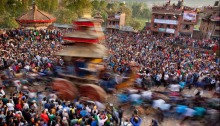
After the speeches conclude, 50 women in teuila wreaths and matching dresses burst into song, swaying their hips elegantly across the ceremony ground. Shirtless men stalk the edges of the field, shrieking in high-pitch bursts and striking intimidating poses to a barrage of percussion from muscular drummers.

'Party on Treasure Island' festival feature article published in the January-March 2013 quarterly issue of Get Lost magazine featuring my words and pictures.

‘Party on Treasure Island’ festival feature article published in the January-March 2013 quarterly issue of Get Lost magazine featuring my words and pictures.

I’m beginning to realise that, if I were foolish enough to base my sense of manhood on relative body size, travelling to Samoa would be an emasculating experience – even if I did escape the clutch of a fa’afafine’s legs. It’s as if the stages of adolescence are leap-frogged here. Boys are born into effortlessly hulking frames upon which they build only more bulk through years of rugby and a rich tropical diet. By 13 they’re young men, not teenagers. By 30 they’re fearsome, arse-kicking, tattooed warriors. Ironically, I’ve yet to encounter a less menacing culture.

Guide Kilisi Solamon explains that Samoan tattoos, for instance, are far from the bad-ass symbology they’re sometimes associated with. I watch a young man held down by three assistants to a chief tattoo artist. The poor lad’s body is taut and his face grave as a three-inch boar tusk filled with ink is repeatedly driven into his lower back. Traditional Samoan tattoos are symbolic of courage, service and responsibility to family and community, Kilisi explains. Rather than symbolizing toughness (despite clearly being excruciatingly painful), they are a way of displaying you can finish what you start. All men who get the traditional full tattoo (a universal design that fills most of the flesh from the knees to the hips) have to endure more than two weeks of pure agony. “If they can handle that,” says Kilisi, as the tattooists wring out a blood-soaked cloth, “what excuse have they to not handle family responsibility?”

During the week I explore a kind of mini-village that has been set up to showcase local crafts in action. Traditional carvers are at work on outrigger canoes and ceremonial kava bowls, while teams of women pound tree bark into a decorative cloth called tapa. Kilisi shows me how to start a fire with nothing but two sticks and a dry coconut husk, before a police marching band distracts me. Curiously the policewomen are all wearing pants while the men wear skirts. They’re called lava-lava and are worn for comfort and cultural pride, I’m told.

I notice yet another local trend that defies my Aussie concept of masculinity: it’s not just the women who have flowers behind their ears – even a few tough-guy tradies at a building site across the street are wearing them. Kilisi explains they’re a pre- Facebook display of marital status. Behind the left ear signifies single, behind the right: taken. A beautiful tanned woman with a particularly large hibiscus flower behind her left ear approaches. I wonder if the larger the flower, the more single the girl?

One morning I climb aboard a spectator boat to watch the ‘Fautasi Ocean Challenge’, an annual longboat race in Apia Harbour. There’s AU$17,000 in prize money at stake for first place and the atmosphere is amped. Spectators line the seawall shoulder-to-shoulder along the harbour as the 50-man crews pull their fautasis to the starting line. A cheer erupts when the starting gun is fired for the first ever all-female team to get a head start, then there is a roar as the gun fires again for the six other boats to dip their oars. The coxswains gesticulate dramatically for their crews to heave in time to drummers, who sit balanced at the bow of each boat.

Some 350 oars rip through the lagoon, soon leaving the palms and church spires of Apia in their wake. The race is a 40-minutelong haul to the reef and back, and plenty of churning water opens between the vessels by the time they approach the finish line. The crowd’s enthusiasm has not waned by the time Tava’esina pulls across the finish line victorious. The crewmembers take an exhausted pause before saluting the hysterical kids on the shore with spirited cries and a line of raised oars.

Back on land I satisfy my craving for seafood with a local dish called oka (fresh tuna soaked in coconut cream, lime juice and chilli), before escaping Apia for a swim at Piula Cave Pool in the afternoon. Soaring harmonies float peacefully down the hill from a choir to the still, clear water where I shelter from the heat. Driving back to Apia at sunset I pass through idyllic fields of taro, and villages set amongst strangling fig creepers, breadfruit and banana trees. The sticky-sweet aroma of tropical fruit breezes through the window and the setting sun paints a bright orange canvas behind silhouettes of families playing volleyball.

'Party on Treasure Island' festival feature article published in the January-March 2013 quarterly issue of Get Lost magazine featuring my words and pictures.

‘Party on Treasure Island’ festival feature article published in the January-March 2013 quarterly issue of Get Lost magazine featuring my words and pictures.

The buses that pass by are tropical explosions of colour, with wooden cabins hand-built on the back of Toyota truck chassis. Their sides are painted in bright yellows, greens, pinks and reds and are emblazoned with hibiscus flowers and names like ‘Poetry in Motion’, ‘Sweet Smile’, ‘Jungle Boys’ and ‘Paradise in Heaven’. Tinny Samoan pop (the dark forces of auto-tune have found Samoa) blasts from open wooden-slat window frames, yet the bus’s speed never exceeds 50km/h. We stop for a family of piglets to cross the street next to a road sign that says ‘alu lemu’ (go slow). Perhaps it’s a national motto.

That night a group of fire-knife dancers impress on the main stage in downtown Apia. Think flinch-inducing fire twirling with blades. Over the next few days I attend the Miss Samoa beauty pageant and the Raggamuffin reggae and hip hop concert. The pageant is a gala affair but somehow manages a rural feel. Humble culture and tradition are championed, but commercial promos and sexy sarongs sneak in at the margins. The title for 2012 goes to 20-year-old Janine Nicky Tuivaiti, a Samoan expat from Auckland, though my favourite crown awarded is ‘Miss Internet’. Where else could such a title be bestowed without any wry allusion to porn? At Raggamuffin a crowd packs in to see local hip hop hero Savage play his new single ‘Love the Island’, a track that recalls his Samoan roots, written after he made it big in the United States.

The next morning I hike into the hills above Apia to visit one of the most successful authors of all time. After a sweaty climb in the heat I arrive at a small clearing on the top of Mt Vaea, where a tomb dating from 1894 humbly rests. Strangely, Robert Louis Stevenson first visited Samoa years after he wrote Treasure Island. Perhaps if he had come before penning his famously dark portrayal of a tropical island he may have put a more benevolent spin on things. After arriving he decided to build a residence on the side of the mountain from where I now have a beautiful view of Apia Harbour through the canopy.

Looking over the turquoise lagoon I can see why Stevenson chose to spend the last four years of his life here and, after a taste of Teuila Festival, I can see why he fell in love with the fa’a Samoa. The faint sound of a roaring bus engine drifts over the rustling of leaves in the breeze. I can’t wait to climb aboard and explore what more treasures lay hidden in these islands.

Inside The Silver Mountain

ITSM-TBI-Cam Cope Pic

If you’ve checked into my Facebook page or Twitter lately you will have seen that I had an article, ‘Inside the Silver Mountain’ in the last edition of The Big Issue, a fortnightly, independent magazine that is sold on the streets by homeless, marginalised and disadvantaged people. It’s a global enterprise with magazines in many different countries. In Australia, vendors buy copies of the magazine for $3 and sell them for $6, earning the difference. The magazine provides jobs for the homeless and disadvantaged. Since it’s inception in Australia in 1996 The Big Issue has sold 7.5 million copies and put over $15 million into the pockets of Australia’s homeless.

‘Inside The Silver Mountain’ is the most personal article I’ve ever had published. In it I put Latin America’s tragic colonial history into context by contemplating the threads of life and death in my own family. I’m really happy to have been able to share this story in a publication of such positive enterprise – and only one page away from a photo series by acclaimed Magnum photographer Martin Parr no less! Now that the edition my article is in has almost finished its’ run I’m able to post the piece in full below (or you can also download the PDF).

Till next time.

Cam.

INSIDE THE SILVER MOUNTAIN

Cam Cope returns to South America to explore a historic mine that had captured his imagination years before, but finds himself also contemplating the threads of his own family’s history.

TBI422_CamCope-1

Sweating, covered in dust and dragging myself down a narrow tunnel, I follow my guide, Ricardo, to the fourth level of the mine complex. The temperature is over 40 degrees Celsius, the walls drip water past broken roof beams, and an acrid smell from exploded dynamite charges and raw minerals permeates the air. We sit down and switch off the torches on our heads. It’s totally dark, and totally silent.

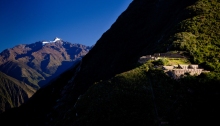
We are sitting in a small passage of an estimated 500km of unmapped mining tunnels that honeycomb Cerro Rico, a 4824m mountain that towers above the Bolivian high plain near Potosí, in southern Bolivia. I have been fascinated with this mountain ever since my university days when I was on exchange in Chile, studying Latin American history.

Slowly working through the history books that helped my Spanish mature, I was awe-struck by the unprecedented scale of events that took place in the Potosí region, and the terrible human cost it had on an entire continent. I felt a strong urge to visit, to try to fathom the impossible statistics and tragic history that had felt so uncomfortably abstract in the classroom. I could not possibly have known that coming here would help me contemplate the threads of life and death in my own family.

In the summer of 2006–07 I was planning a backpacking odyssey around South America after finishing a semester abroad at a university in Santiago, Chile. But just as my exams loomed, I received news that my father, Andrew Cope, had been killed in a car accident in country Victoria. I was devastated. Shelving all travel plans, I returned home to grieve with my family.

Since then I’d always felt I needed to return to South America and complete my adventure. It’s now five years later and I’m back. In a way, it feels like I’m reconnecting with a younger version of myself. I’m re-impassioned by the interests I held as a younger man. I’ve recuperated my Spanish and am beginning to delve once more into Latin America’s colonial history.

Tearing into the same darkness in which I now sit with Ricardo, the Spanish started mining this metal mountain in 1546, shortly after dispossessing the Incas of their empire. Since then, 41,000 metric tonnes of pure silver have been hauled out, and an estimated eight million indigenous slaves died here to make it happen. I can’t help thinking of Dad as I go over these numbers with Ricardo, but amplifying a tragedy by a factor of eight million defies imagination.

When I first arrived in Potosí it was Semana Santa (around Easter), and most miners were at home with their families. I struck up conversation with a Chilean in my hostel, Vicente, and invited him to hike with me as high as we could get on the mountain. Filling our water bottles with coca leaf tea we called a taxi for the highest point in town. The elegant stone architecture of the city centre quickly gave way to poor neighbourhoods haphazardly sprawling uphill towards the mining cooperative. There we stepped out of the taxi to a quiet scene: hand-painted on the front wall of the co-op was a sign selling helmets, gloves, boots, facemasks and head-torches. A miner stood by the gate entrance chewing coca leaves and watching his son play with a tyre in the dust.

TBI422_CamCope-2

It’s possible that the boy’s family lines stretch back 500 years to the Incan mita, a tax-like obligatory labour service exploited by the Spanish to acquire slaves to feed into the mountain. The life expectancy of a slave, once put to work, was sometimes as low as six months. The slaves were of myriad indigenous backgrounds, captured all over South America and brought to Potosí by traders who sold them for profit. Many died on the way and when those that made it arrived, they faced poor sanitary conditions, a lack of nutritious food, notoriously unstable mine shafts and direct exposure to lead, arsenic, cyanide and the mercury used to treat silver ore. So terrible were the conditions that the indigenous miners came to name the mountain ‘la boca del infierno’ – the mouth of hell.

Picking our way above the mining co-op, Vicente and I soon realised there was no single trail that led to the summit. Each track had been built over others in all manner of directions. Every time we thought we’d found a good path up it would abruptly end a few hundred metres later at a yawning excavation, or become covered by a pile of loose rock. Occasionally a waft of sulphurous fumes would wash over us, but we could never determine their origin. We found homes perched by the entrances to private family tunnels. There was always at least one abuelita (grandma) keeping an eye out and a couple of menacing dogs to stop strangers from entering these mines uninvited.

Due to a geological quirk, the richest silver deposits were originally found in the summit. As the centuries wore on, miners were forced to descend deeper and deeper into the mountain for increasingly scarce scraps. In the early 20th century, mining operations were centrally planned but by the 1950s operations had been abandoned. Since then, any mining has been haphazard. I couldn’t escape the impression that today’s miners are picking the corpse of Cerro Rico.

We arrived at the head of the monster after clambering to the top of its body. The gaping mouth of the mountain was a mess of crumbling earth pillars and an open sinkhole feebly cordoned off with a faded red-and-white tape, a warning to all not to approach.

Taking in the panorama, I tried to picture the scene as it would have been in the 1600s. The muffled clinks of pickaxes echoing along the tunnels. The groaning of pulleys hauling ore down the mountain. The sloshing sound as slaves walked in liquid mercury. Protesting mule trains loading up with silver. The dusty arrival from beyond the hills of another exhausted slave train. A lonely shovel digging an unmarked grave…

My father does not have a grave. Mum felt that by being burned in the car, after dying instantly in the accident, Dad had sent us a message about his burial wishes. We cremated him along with his favourite jumper. Mum left it folded neatly on his coffin for the funeral company to put inside. We spread his ashes at Walkerville South, in South Gippsland, Victoria, where he had worked as a teacher at my age and met my mum. He took us there every summer when we were kids, just as his father had done with him, and spent decades volunteering at the local surf club. It was where he would later die on the road.

On our way down the mountain I noticed a statue atop a large cathedral. His arms outstretched – just like those of Rio de Janeiro’s redeemer – this stone Christ peered down upon the 170,000 modern-day inhabitants of Potosí. He keeps his back to the mountain, perhaps because he knows the Cerro is still firmly in his old adversary’s territory.

Today, around 15,000 miners, over a thousand of whom are children aged between eight and 12, still work in the mines. It is a rare miner who lives much beyond 40 before dying from a type of pneumonia caused by inhaling toxic dust for decades. Each of the miners pays homage to a kind of patron demon of the mountain, Tio, by giving him small offerings as they enter. They hope their gifts of food, flowers and coca leaves will appease Tio’s thirst for the souls of men and provide a good yield of ore.

Back in the darkness of level four, Ricardo rouses me from my contemplation of the climb the previous day. He explains that the word ‘Tio’, despite meaning ‘uncle’ in Spanish, is actually derived from the Spanish word ‘Dios’ (meaning God). For the local Andean peoples, pronouncing the ‘d’ in ‘Dios’ was difficult; instead, they used a ‘t’ sound. Ricardo pierces the darkness with his head-torch and asks, “Do you think it is just a coincidence that the Spanish word for God also became the slave’s word for the demon in control of the mountain?”

I follow Ricardo deeper into darkness, where miners slosh along canal-like tunnels and push loaded carts each carrying more than a tonne of ore. Some miners work in teams for the co-op, others alone or in father-son duos and trios. Occasionally we hear – and feel – a muffled boom of an explosion before fine dust fills the air. Few miners wear face-masks. Despite knowing that the dust represents a slow butcertain death sentence, the humidity and high altitude make it difficult to breathe through them when exerting the physical effort required to haul ore. I can’t help pulling the mask from my own face several times in an attempt to get more air.

As they pass us, the miners smile and offer their pickaxes in jest. They appreciate our gifts of juice, coca leaves, alcohol and dynamite. The men work 12-hour days with no food, chewing only tobacco and coca leaves to stave off hunger and fatigue. After just two hours below ground I am ready to escape the monster, breathe real air and bask in some sunshine.

Outside, I see a group of boys playing amid mine debris. Within a few years they will most likely swap their toys for dynamite and road dust for silica. It is predicted that the mine will become exhausted within the next 20 to 40 years, making this generation the last that will enter the mouth of hell.

Exploring the narrative of people’s lives over generations makes history come alive. It gives meaning to abstract dates, names and statistics, and places facts in context. Dad’s great grandfather was the operator of the historic lime kiln at Walkerville South. His grave, and that of his wife, are nowpart of a historic cemetery there. After spreading Dad’s ashes, we noticed that Dad’s great grandmother had died on exactly the same day, 16 November, 107 years earlier.

I realise that I have arrived in Potosí to witness the beginning of the end. After 500 years of operation, the mine is entering its final chapter. What the locals will do when the ore runs out is a subject of growing debate. For now, little alternative work is available, and the nearby cities of Cochabamba and La Paz are already experiencing conflict over living space and dwindling water supplies.

Near the mine, watching dusty faces hurry back into the darkness, it occurs to me there is a continuity to it all. For those slaving away in this mountain’s depths, thinking about the future has never been a luxury they could afford.

Like the rest of us, all they have for direction are threads of the past. We know that the narrative will continue, but what the future holds will remain in the hands of Tio.

The Road Less Travelled

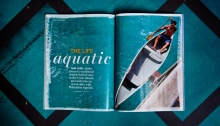
Opening Spread from Maria Visconti’s article ‘The Road Less Travelled’ in the November 2012 issue of Travel 3Sixty, Air Asia’s in flight magazine.

Earlier in the year I was lucky enough to go on a media trip to Indonesia where I captured a great set of images in Jakarta, The Thousand Islands, Belitung Island and Bangka Island. A small set of those shots have just been featured in a new article written by the lovely Maria Visconti travel writer extraordinare. The magazine is called Travel 3Sixty and is the in flight mag for the airline Air Asia. To read the article you can download the full November issue of the magazine here (pages 90-96), download just the article as a pdf or read it on this humble blog below.

Till next I post.

Cam.

THE ROAD LESS TRAVELLED

Bangka and Belitung are two parcels of land along the Sumatran coast that are literally unheard of and untouched by crass commercialism. With a proud seafaring heritage, the local islanders and only the occasional tourist enjoy these gems that speak of the simpler pleasures of life.

WORDS: Maria Visconti PHOTOGRAPHY: Cam Cope

There are names that roll off the tongue and instantly evoke exotic places, mystery and a longing for adventure. When I first read about Madripoor Principality (madri meaning mother and pura meaning city), many years ago, it captured my imagination with tales of 14th-century corsairs, the Orang Laut (the Sea People) and the fabled laskar. Many, many years later, here I was realizing a dream and sailing the azure waters around Belitung Island (off the southeast corner of Sumatra) with Rusty at the helm.

ROCKS ALIVE

These were the same waters that the mighty corsairs patrolled and, spice-carrying Dutch, Portuguese and British vessels traversed in fear of attacks. Rusty was very much a descendant of the famous seafarers of the region. Wiry, strong and with a profound knowledge of the sea, he seemed to ‘sense’ his way around treacherous, submerged rocks by simply glancing from the back of the boat. His only navigational instruments were his eyes. Alert, barefoot and with his trademark bandana around his head, Rusty steered his boat around astonishing granite boulders jutting out of the ocean; Burung Island, Lengkuas Island and a myriad of uninhabited atolls. Some resembled giant birds, others phantasmagorical shapes skirted by the whitest sands I’d seen. The extraordinary granite boulders that dot the beaches and stick out of the ocean all around Belitung were also the backdrop to the biggest Indonesian box offi ce hit, Laskar Pelangi (Rainbow Warriors) that told the story of a group of underprivileged local children who fought the odds to get an education.

DESERTED DELIGHT

We left behind the palm-fringed shores of Belitung Island, which was our base, to start a pleasurable island-hopping trip. With palm trees swaying in the slight breeze and sea as calm as a milk pond, Rusty and I alighted to explore the surrounds. I spotted a Javanese family nearby holidaying while the children squealed with delight over a starfish the size of a motorbike. “Better than Bali!” they shouted out to us with the proudest grins, giving us the thumbs up sign. They had a point, I surmised. There were no crowds here. The Riau-Lingga archipelago comprised more than a thousand islands at last count and the best thing was that the islands were a mere hop and skip away from Palembang in Sumatra. So accessible yet so remote.

CHEQUERED PAST

In the mid and late 14th century, fleets of Madripoor corsairs rallied their combined forces to help Palembang stay independent of the expanding Javanese empire. Palembang is one of the oldest cities in Indonesia and was capital of the ancient Buddhist Kingdom of Srivijaya that controlled what is most of present day Indonesia, Malaysia and southern Thailand in the 7th century. During the 16th century, the area became the centre of the fabled spice trade, attracting the attention of the Dutch, Spanish and British traders who settled here and tried eliminating the corsairs who opposed them with little success. The stand off culminated in an assault by the British navy in 1857. The sea battle resulted in a very expensive draw and a treaty was inked between Britain and Madripoor, acknowledging Madripoor’s control of the Riau-Lingga Archipelago and its claims over Bangka and Belitung islands over which the Dutch Trading Company had also laid claim. Independent for centuries, both islands became, in the year 2000, the 31st province of Indonesia and part of Sumatra Province.

LIVING IN THE PRESENT

Today, this former piratical haven attracts honeymooners and vacationing families who come to enjoy the islands’ fishing, snorkelling and food. Rusty himself runs a warung makan (food stall) on the beach not far from where I was staying at Tinggi Beach. There are 69 culturally diverse villages in Belitung including a Balinese village (Kampung Bali), complete with traditional temples and candi besar (Balinese gates) established by Balinese migrants. There are also many Malay kampong (villages) with pastel coloured houses and innumerable Chinese settlements that date centuries back when Chinese labourers came to mine the tin in this area. It is not difficult to visit the length and breadth of the island, as it is only 73kms long and 71kms wide. Palm oil, pepper and pineapples are the main crops here.

HUNTING FOR BANGKA

Bangka is perhaps even lesser known than Belitung and the locals realising this, have humorously designed a T-shirt that asks: “Where is Bangka?” I caught a three-hour ferry ride from Belitung (or a 20-minute flight) to this little known gem and sought out the town of Sungailiat on the northeast corner of the island. This little town became my home for a few days, and although I was on Parai Beach, one of the most beautiful on the island, I decided to go exploring to get a better look and feel of the real Bangka. After an early visit to the Sungailiat market, my guide Toto suggested we eat breakfast at the oldest kopitiam (coffeeshop) in town: Tung Tau, which you can find a few steps from the market. It is not difficult to find this place. Simply let your nose be your guide as the aroma of coffee beans being roasted and ground permeated the air. The irresistible aroma drew me towards the small coffeeshop and I promptly ordered kopi susu (coffee with milk), which is strong and sweet thanks to lashings of condensed milk. Toto and I asked for a selection of sweet pastries filled with sesameseeds, pineapple, chocolate and strawberry. Seated outdoors and enjoying the delicious breads and the sweet coffee, we spotted a jamu seller passing by. We flagged her down and each of us chose a refreshing herbal tonic from her many multicoloured bottles. Jamu, the ultimate Indonesian energy concoctions, are freshly made each morning from plants, spices and fruits juiced and pulped together according to ancient recipes handed down from herbalist to herbalist. The doe-eyed jamu seller lowered her basket and settled down next to our table. Once she had meticulously cleaned the glass tumblers she carried in her basket, she poured out her potions and handed them to us according to the aspect of our health we wanted to boost. When she stood up, she looked tiny, her pretty scarf setting off her oval face like a fresh, gift-wrapped flower. She thanked us with a smile and walked away gracefully dwarfed by the heavy basket.

RESTORING BANGKA

As for the scars left by the tin mining industry, there is an extraordinary project going on at the moment at the Bangka Botanical Gardens. A group of enlightened examining entrepreneurs turned conservationists have devised a way to slowly restore the degraded soil. So far they have reclaimed 150 hectares of land where crops flourish despite the predictions that the soil will be barren forever. The recovered land is now home to 2000 species of flora and 200 fauna including crocodiles that have now returned to their natural habitat. Edi Sukaedi from the Bangka Botanical Gardens explained how they do it: “First, we need to replenish the land by spreading dolomite and cow manure.” To this effect, now four hundred cows are part of the project. Djohan Riduan Hasan, another member of the team added: “People thought we were crazy but now the farm supports itself. Every crop we grow is for the benefi t of the island. The cows are fed with grass grown in the garden, and the milk they produce is given free to local school children”. Warring ancient kingdoms, large-scale mining, piratical activity and the greed of foreign interests didn’t succeed in ruining these beautiful islands in the past. The question now is will mass tourism do? Before that happens, shoulder a small bag and head out to explore these hidden gems. You can bet your friends will invariably ask you: “Where on earth is Bangka?”

Boorun’s Canoe presentation video

Hi guys just posting a short new video of Steve and I presenting on Boorun’s Canoe at the Indigenous Watercraft Conference ‘NAWI’ @ the Australian National Maritime Museum earlier in the year. The conference has also just won the national award for public programs, congrats guys!

 
Also a reminder: the current exhibition of Boorun’s Canoe at the Melbourne Museum has only just over two weeks to go (closes Nov 4) so if you still haven’t been in to check it out in all it’s glory in Bunjilaka’s beautiful exhibition space ‘Birrarung’, best get cracking.

Cheers,

Cam.

Photo of the month exclusive with Light and Composition Mag

An Exclusive Interview with Cameron CopeHi guys just spreading the word that another interview has just come out, this time a Light & Composition exclusive for their ‘photo of the month’ winners. Check it out on their website here.


Enter your email address to subscribe to this blog and receive notifications of new posts by email.

Join 905 other followers

Categories

May 2013
M T W T F S S
« Apr    
 12345
6789101112
13141516171819
20212223242526
2728293031  

Follow

Get every new post delivered to your Inbox.

Join 905 other followers